You can play good golf without warming up. You probably already have. You're young, you feel fine, and some of your best rounds might have started with walking straight to the first tee. None of that is wrong.
But here's what's worth understanding if you're serious about getting better: feeling ready and being calibrated are two different things.
Your body runs an internal awareness system called proprioception. It's the reason you can close your eyes and touch your nose. It's the reason you can feel the difference between a thin and a flush strike without watching the ball. Proprioception is your nervous system's real-time read on where everything is — where your hands are in space, how much tension is in your hips, what your spine angle is doing at the top of your backswing. In most sports, proprioception matters. In golf, it might matter more than in any of them, because the margins are so small. A few millimeters of club face angle at impact. A fraction of a degree in hip rotation. The difference between the shot you planned and the shot you hit is often a proprioceptive difference.
That system's precision isn't fixed, though. When your muscles are cold and your joints haven't moved through their ranges, the signals your body sends your brain are less precise. Not wrong — less precise. You still know where your hands are. You just don't know as exactly. And in a sport where exact is the whole game, that gap matters.
A warm-up closes that gap. When you move your body through progressive ranges of motion, a few things happen. Your muscles warm up, which literally increases how fast they can contract and how much force they can produce. Your tendons and ligaments become more compliant, which means your joints move more freely through their full range. And your proprioceptive system calibrates — the signals sharpen, the internal map gets more detailed, and your nervous system starts operating with better data.
Now here's where this connects to actually getting better at golf, not just playing a better round.
Practice is when improvement happens. Not rounds — practice. Rounds reveal where you are. Practice is where you change where you are. And the quality of your practice depends on the quality of the reps you're putting in. If you're practicing with a system that's operating at 85% of its resolution — muscles a little slower, proprioception a little fuzzier, joints not quite at full range — then every rep you take is a slightly less accurate version of what you're capable of. You're grooving a pattern, but it's a pattern built on less precise feedback.
Warm up before practice, and the reps get sharper. Your body gives you more accurate information about what just happened on each swing, which means your adjustments are more accurate, which means the pattern you're building is closer to what you'll actually need on the course. You're not adding talent. You're getting more out of the talent you already have.
This takes about eight minutes. Here's exactly what to do.
Sensory Calibration
~2 minutes
You're calibrating the proprioceptive system before you ask anything of it at speed. This is the most overlooked part of warming up for golf specifically.
Foot Wake-Up
60sSingle-leg stance, eyes open for 15 seconds per side, then eyes closed for 15 seconds per side. Your feet are loaded with mechanoreceptors — pressure sensors that feed your brain information about weight shift. This wakes them up before you ask them to manage the weight transfer in your swing.
Vestibular Prime
60sSingle-leg stance with slow, deliberate head rotations — horizontal then vertical, 15 seconds each direction per leg. This calibrates your gaze stability during trunk rotation, which is the specific sensorimotor demand of the golf swing. Your eyes need to stay locked on the ball while your body rotates around them. This is how you prepare that system.
Activation Under Load
~6 minutes
Now that the sensory system is calibrated, you're turning on the muscles that stabilize and produce force in the swing — under resistance, in patterns that are closer to what golf actually asks of your body than generic stretching provides.
Banded Crab Walks
75sMini-band above your knees, theraband behind your back with a pistol grip, circle your hands backward while side-stepping. 20 steps each direction. This hits your glute medius, scapular stabilizers, and postural integration in one movement.
Banded Speed Skaters
75sMini-band above your knees. Skate back and out to the side, alternating legs, controlling the landing on your front leg with a slight squat before returning tall. 6 reps each side. This is single-leg glute loading with deceleration control — it's closer to the trail leg demand in the downswing than any bilateral exercise gives you.
Banded Lunge and Rotate
75sBackward lunge away from a band anchor, rotate over your front knee. 6 reps each side. Hip dissociation under resistance plus rotational sequencing through the thorax — separating what your hips do from what your upper body does, which is the fundamental movement skill in the golf swing.

Stomp and Rotate
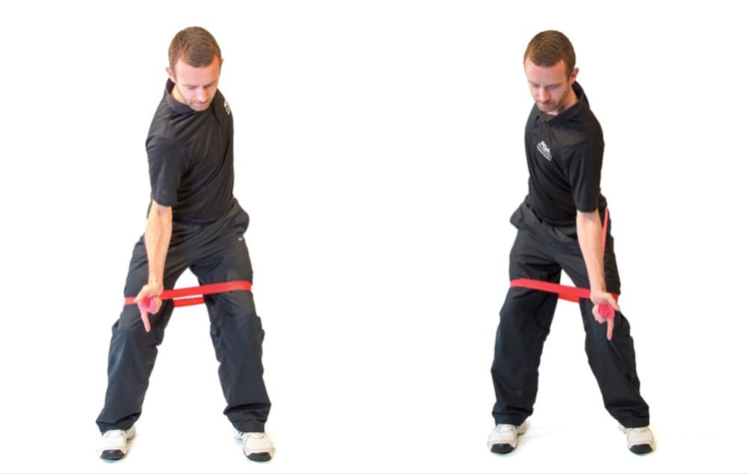
75sBand around your legs, band between your hands, foot stomping with rotation into backswing and follow-through positions. 30 seconds on, rest, 30 seconds on. This combines ground reaction force patterning, rotational sequencing, and band resistance at the same time. The stomping recruits your fast motor units without asking for max effort — you're priming the explosive system, not exhausting it.
Eight minutes. Do this before every practice session, before every round. The golfers who figure this out early don't have more talent than the ones who don't. They just get more out of what they have, every time they pick up a club.