Cardio Makes Everything Easier
Think about the most demanding thing you did this week. A flight of stairs with grocery bags in both hands. Getting up off the floor after playing with your kids or grandkids. The hour of pickleball, the round of golf.
Every one of those tasks demands a fixed amount of work. What changes is how much effort is needed for each task.
Your body has a ceiling - the most oxygen it can take in and put to work when you're going as hard as you can. This is your aerobic engine. This is your VO₂max. When that ceiling is high, the stairs are a small fraction of your capacity. When that ceiling is low, the same stairs use a lot of it.
So fitness doesn't change the task. It changes the amount of effort you use.
The fitter you are, the smaller the percentage of yourself any activity costs you. This is why cardio is important — so you have more energy for the things you enjoy in life. When people say they want more energy, or want to keep up, they want a bigger engine, so the demands of an ordinary day don't cost them as much.
So how much is enough to really make a difference?
You Don't Have One Cardio System. You Have Two.
Cardio is often presented as one thing and because of this, advice can often sound contradictory. Common fitness advice will say walking is plenty while fitness advice from somewhere else will say that unless it’s hard it really doesn’t count.
But cardio isn't one thing. Your cardiovascular systems adapts in different ways built by two different demands, and "how much" has a separate answer for each.
Let's call this two part system the base and the engine.
The Base: Built by Volume, and It Maxes Out
The base responds to total volume rather than how hard any single session is. The base influences our everyday health by influencing how well your body handles insulin and how much low-grade inflammation you carry. These improve with the sheer amount of not-sitting you accumulate.
Easy movement and cardio is the kind you can accumulate in real volume, because it barely costs you anything to recover from. You can walk every day. You can't go hard every day. That's why the base is built by easy volume — not because hard work doesn't help the metabolism (it does, often more per minute), but because easy work is the only intensity you can do enough of, day after day, to build a foundation.
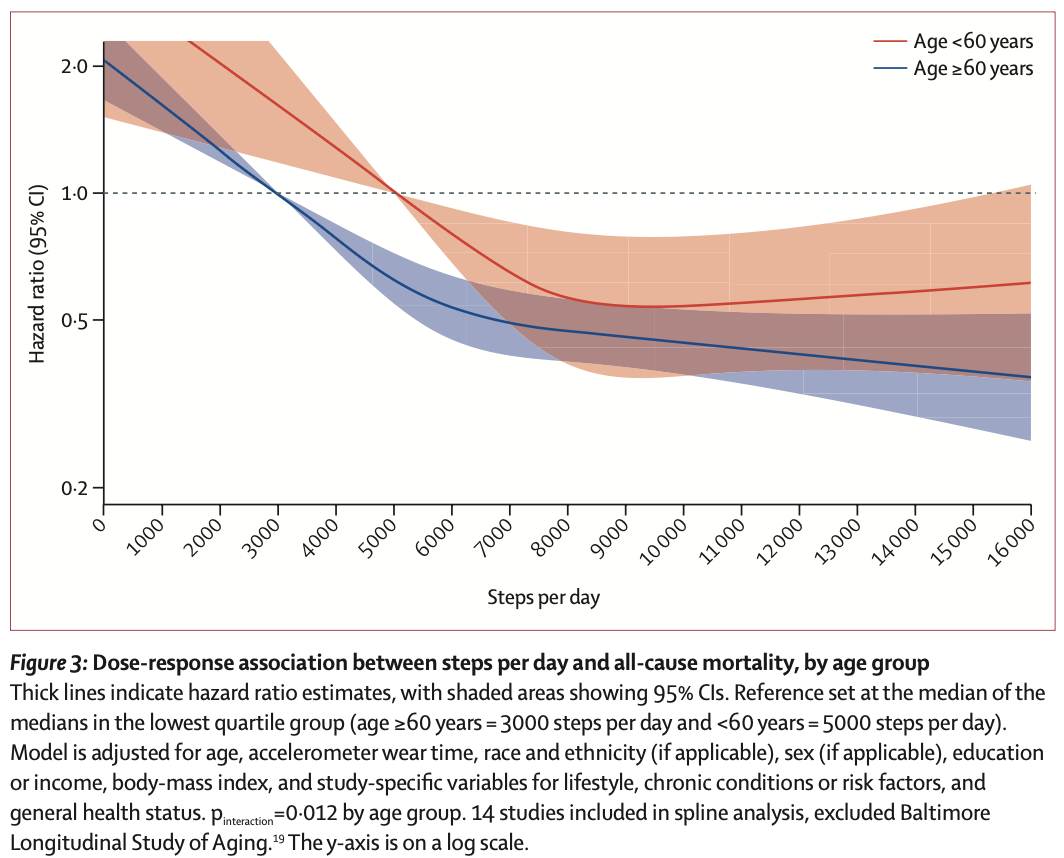
The base matters, but building it eventually plateaus. A large study tracked how much people walked and how long they lived.
Compared to the least active group, the next group up had about 40% lower risk of dying. The group above them, 45%. The most active, 53%. But the benefit leveled off. For adults over 60, it flattened somewhere around 6,000 to 8,000 steps a day. For younger adults, 8,000 to 10,000. Past that, more steps kept the base in place but stopped lowering risk much further. See the red and blue lines flatten in the picture above.
That plateau is the important part. Once you're walking enough, the base is built. More walking keeps it there, but the benefits level off. If walking were the only important aspect of cardio, you'd be done - but the base is only the foundation.
The Engine: Built by Intensity
The engine is different.
This is the ceiling: how much blood your heart moves per beat, how supple the main pumping chamber stays. This determines how much oxygen can get delivered throughout your body. It's the part tightly tied to reducing the risk of a cardiac event, and it's built by intensity — sustained hard efforts, where your heart is moving a lot of blood for minutes at a time.
One large study managed to do something most can't: it separated how much people moved from how hard they moved, then tracked who lived. Picture the two people it compared.
The first one walks more. More steps, more easy movement, more days on their feet. Good — that's the base, and they'll live longer for it.
The second one keeps their walking the same but adds intensity. A couple of times a week they push to where it's genuinely hard — biking, rowing, basketball. The activity matters less than the intensity.
Both come out ahead. But the second person comes out further ahead.
For both, the added walking lowers their risk of dying. However, the added intensity lowers it more than twice as much. And for heart disease specifically, the extra walking helped only a little, while the intensity helps a lot more.
More walking is good for almost everything. For the engine, intensity is what does the work.
Why Does Intensity Matter?
Your heart's main chamber fills with blood between beats, then squeezes it out. How much it fills depends on how easily it stretches. A younger heart is supple — it takes in a full load, so every beat moves a lot of blood. Over the decades it can stiffen, fill less, and pump less per beat, leading to a smaller engine. The engine doesn't shrink because the muscle got weak; it shrinks because the chamber stopped filling all the way.
That stiffening looks like aging, but much of it is disuse. In a two-year study, sedentary adults in their early 50s trained four to five times a week, intervals included. The chamber grew supple again — closer to someone years younger — and their oxygen ceiling rose 18%. A control group doing stretching and balance work saw no change.
When it comes to getting these structural changes the timing matters. When the same training was tried on sedentary adults past 65, the chamber's stiffness didn't change — that particular remodeling responds best when you start earlier. This is the strongest argument for taking intensity seriously in your 40s and 50s. Before 65 the structural adaptations are still fully available, but past around 65 not all the adaptations continue to occur. The rest of the system still respond, the ceiling still rises with training, the base still builds — but the biggest changes to the engine rewards a start before 65. The rest rewards starting whenever you do.
So, How Much?
Two systems, two doses.
The base is a volume target: somewhere around 6,000 to 8,000 steps a day if you're over 60. 8,000 to 10,000 if you're younger. The intensity check for all of it is the talk test — you should be able to talk while you move. If talking is getting difficult, you've drifted out of base work.
The engine is a frequency target. A couple of sessions a week where you push to genuinely hard — hard meaning you could get out a few words, not sentences — and hold it there for minutes at a time. Biking, rowing, hills, a sport that forces it. The activity doesn't matter; the sustained, breathing-hard minutes do. If you haven't trained hard in years, start with one session a week and shorter efforts(30-60 seconds), and build from there.
One mistake that I often see people make once they decide to take cardio seriously is that they train in the middle. Every session somewhat hard — breathing heavy, sweating, but never all the way easy and never all the way hard. This results in working too hard to accumulate the volume that builds the base, and not hard enough to signal the engine. It can still get results but it’s one reason why I see people repeatedly start and stop incorporating cardio into their routine.
Splitting between hard sessions and easy sessions works best in my opinion because of how the body adapts. The hard session doesn't build anything while you're in it — it sends the signal. The chamber is forced to stretch and the body adapts over the following days, while you recover. If the days between are medium-hard instead of easy, you arrive at the next hard session too tired to go genuinely hard, and the signal never gets sent. Keeping the easy days easy is what makes the hard days work.
Where to Start
Where you start depends on which system needs the most work, and your phone can tell you half of that right now. Look at last week's step average. If you're already near that 6,000-to-8,000 range, your base is mostly built — more walking while still beneficial isn’t going to lead to major changes. That means adding 1-2 hard sessions a week.
For most people who already move, this is where the gap is. Nothing in their week is genuinely hard. If that's you, the starting point is one session. 30 seconds walking, biking, running, swimming or engaging in one of your favorite activities at hard effort followed by 2-3 minutes easy and then repeated cycles of hard for 30 seconds then easy for 2-3 minutes. Do this for twenty minutes, pushed to where talking stops being an option, held there in stretches and build from there.
References
On step counts and longevity (the plateau at 6,000–8,000 steps):
Paluch AE, et al. Daily steps and all-cause mortality: a meta-analysis of 15 international cohorts. Lancet Public Health. 2022;7(3):e219–e228.
On volume vs. intensity:
Wei J, et al. Volume vs intensity of physical activity and risk of cardiovascular and non-cardiovascular chronic diseases. European Heart Journal. 2026.
On reversing cardiac stiffening in middle age (the 18% VO₂max increase):
Howden EJ, et al. Reversing the cardiac effects of sedentary aging in middle age. Circulation. 2018;137(15):1549–1560.
On training after 65:
Fujimoto N, et al. Cardiovascular effects of 1 year of progressive and vigorous exercise training in previously sedentary individuals older than 65 years of age. Circulation. 2010;122(18):1797–1805.